 Glasgow Go Club
Glasgow Go Club
Glasgow Go Club
 We meet Thursdays, starting about 7pm, at the Curler's Rest
Pub, in the upstairs room. The pub is on Byres Road, G12 8SH. Take
the Subway to the Hillhead Station, and the pub is just a couple of
doors to the right.
We meet Thursdays, starting about 7pm, at the Curler's Rest
Pub, in the upstairs room. The pub is on Byres Road, G12 8SH. Take
the Subway to the Hillhead Station, and the pub is just a couple of
doors to the right.
(Note that the venue has changed in December 2016.)
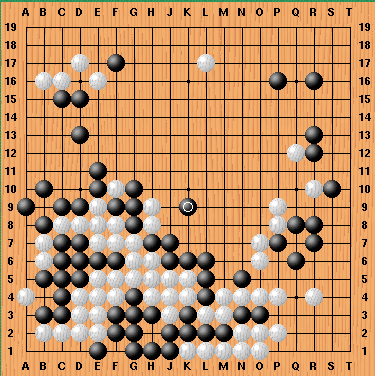
Go is a game for two players, and winning is based purely on skill (no dice or cards). The aim of the game is to place your stones on the board so as to surround a larger amount of territory than your opponent. There is an effective handicap system that enables two players of different skill to have a fair and enjoyable game. This diagram shows a position in the middle of a professional game from the early 20'th century, the famous "group capturing masterpiece".
In order to improve, it's helpful both to play many games (especially with stronger players), and also to read some of the many excellent books on go. Here are some sources for books and equipment, as well as general information:
David Carlton has an excellent annotated bibliography giving brief reviews of most of the go books available in English.
Although many good books on go have been published, few bookstores carry them. It's easiest to buy go books from national organisations, like the British Go Association, or through specialist publishers and retailers:
The rules of go are extremely simple, and there is also a more formal set of rules you might find interesting.
Every year the Scottish Open Go Tournament attracts players at all levels, from rank beginners to extremely strong experts, from all over Britain. This is the chief Go event in Scotland.
The Dundee Go Club meets regularly; see their page for time, place, and contact addresses.
The Edinburgh Go Club meets regularly; see their web page for time and place.
It is also possible to play against a computer. Many computer go-playing programs have been written, and they are interesting for computer science researchers interested in artificial intelligence. However, these programs are rather weak by human standards, and they are really suitable only for beginners.
Computers are extraordinarily strong at playing chess, and it's possible that the world chess champion will eventually be a computer. However, the chess programs based on artificial intelligence aren't as strong as the systemd that just use special hardware and efficient coding to perform brute force search. It turns out that with current computer hardware, it's possible to consider enough chess positions quickly enough to pick a good move, without using any intelligence at all - artificial or otherwise.
The reason that go programs aren't as strong is that go as far more complex than chess, in the technical sense of computational complexity. Brute force search is useless for go, while it leads to grandmaster play for chess. The only hope for a go-playing program is actually to introduce artificial intelligence into the program. This can be done, but the results so far are relatively modest, for both go and chess.
One way of looking at it is that the problem of playing chess by computer, which started out in the early 1950s as a research topic in artificial intelligence, has become uninteresting because the alternative unintelligent approach of exhaustive tree searching is so much more effective. In contrast, the exhaustive techniques don't work for go: the real research problem for artificial intelligence in game playing is to produce a strong go program.
If you want to learn how to play go, the programs currently available may give some good experience, but it's very important to see what good moves really look like, and for that you will need a strong human opponent.
