
 |
My Research |
|||||||||||||||||||||||||||||||||||||||||||||||||||||||||||||||||||||||||||||||||||||||||||||||||||
|
||||||||||||||||||||||||||||||||||||||||||||||||||||||||||||||||||||||||||||||||||||||||||||||||||||
Paul is a member of the Computer Vision and Graphics group View My Stats W Paul Cockshott wpc@dcs.gla.ac.uk, Translated versions of my page Latvian by Arija Liepkalnietis Finnish by Fijavan Brenk |
Realising
massively
concurrent
systems
on
the
Space
Machine
:
hdv-29-93
Use
of
high speed cellular automata to simulate road
traffic : hdv-27-93 A presentation of how
the space machine can be applied to road traffic
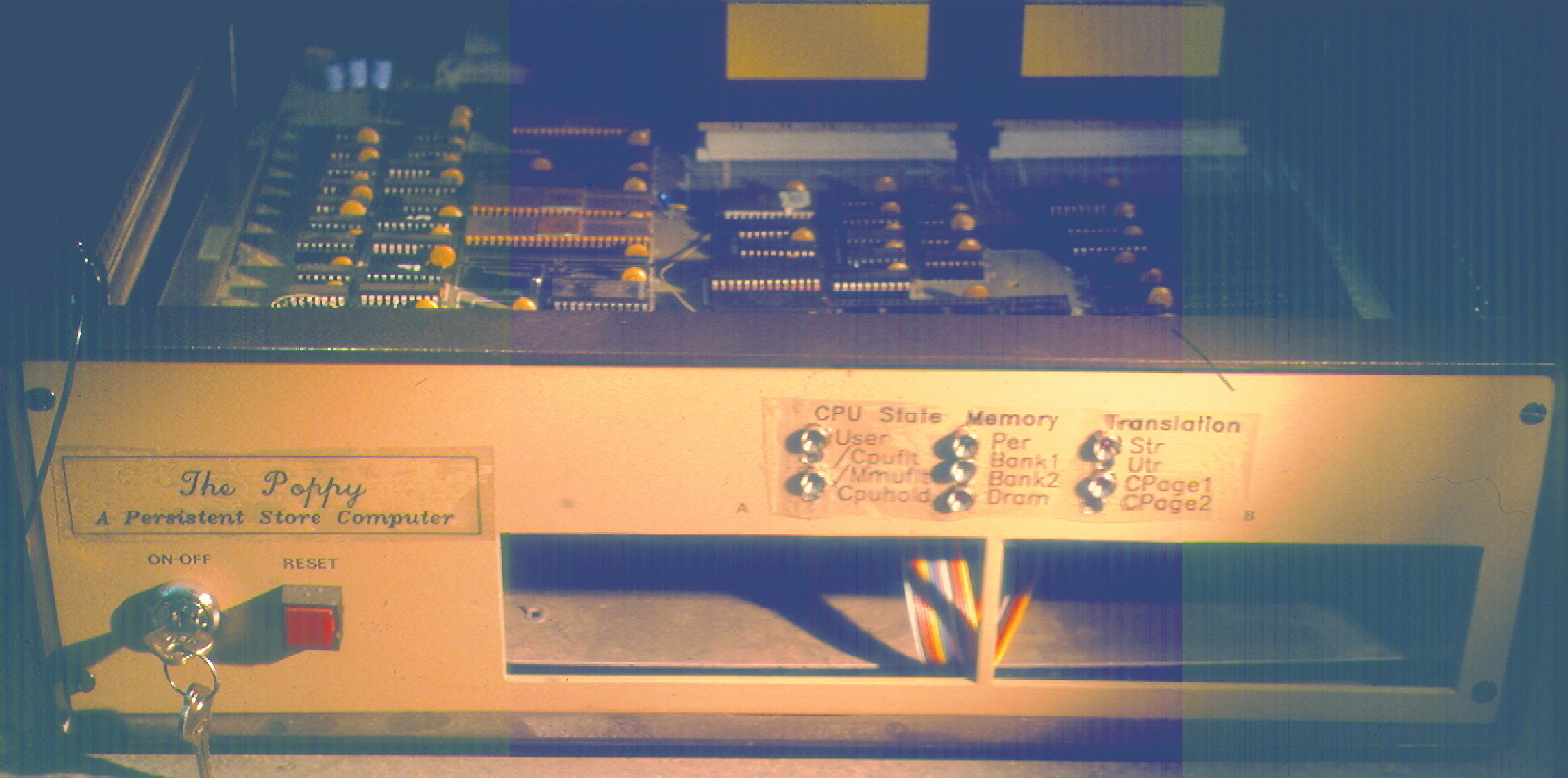
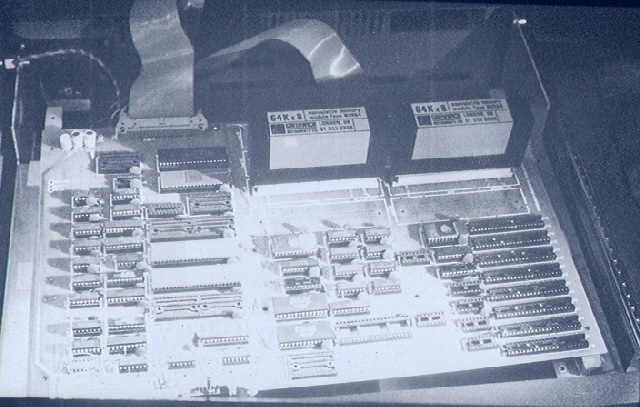
simulation. The PoppyBuilding
a
microcomputer with associative virtual memory,
this describes the Poppy a 64 bit address space
workstation I designed and built at Glasgow
University in 1985 with funding from Acorn to
support persistent programming languages.
During the 1980s I worked on persistent
programming - the idea of having a programming
language in which the variables and heap are
preserved over successive invocations of the
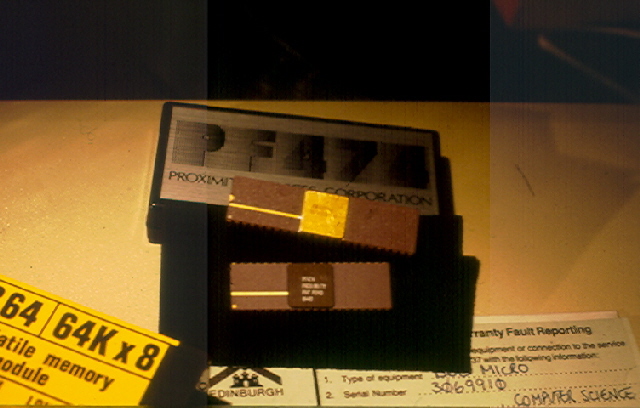
programme. The machine had a memory management
unit specifically tailored to persistent object
oriented programming, and mapped active pages to
battery backed ram chips for transactional
reliability.
E-DemocracyLeadership Democracy and Transitions. Verbatim transcript of a talk given at the Workers Educational Association in Stockholm in Nov 2010, covering the ideas of direct democracy in the early Social Democratic movement and how these were lost during the 20th century and the catastrophic effect this had in countries like Russia. My thanks to Joonas Laine for recording and transcribing the talk. See also the SLIDES which went with the talk. Extending Electronic Democracy to cover Budget decisions. A paper that describes how multidimensional decisions about taxes and expenditure can be decided in a consistent and secure way using mobile phone votes. There is a growing realisation that the populace need to be consulted on a more regular basis about issues that concern them. We address a particular economic problem, that of national budgeting, and show how digital technology can be applied in an understandable way in this domain. The current situation is that governments are reluctant to conduct plebiscites due to the expenses inherent in the traditional voting model. Handivote is a system which allows maximal participation, using a ubiquitous input mechanism, the mobile phone, to support decision-making. In this paper we show how the Handivote system could be extended to invite voter input into national economic decisions. Our proposal includes an algorithm which maximises voter satisfaction in the presence of budgetary constraints, and the preferences revealed by the vote. Slides for the talk. Art Exhibition containing work from me
|
|||||||||||||||||||||||||||||||||||||||||||||||||||||||||||||||||||||||||||||||||||||||||||||||||||



 |
|
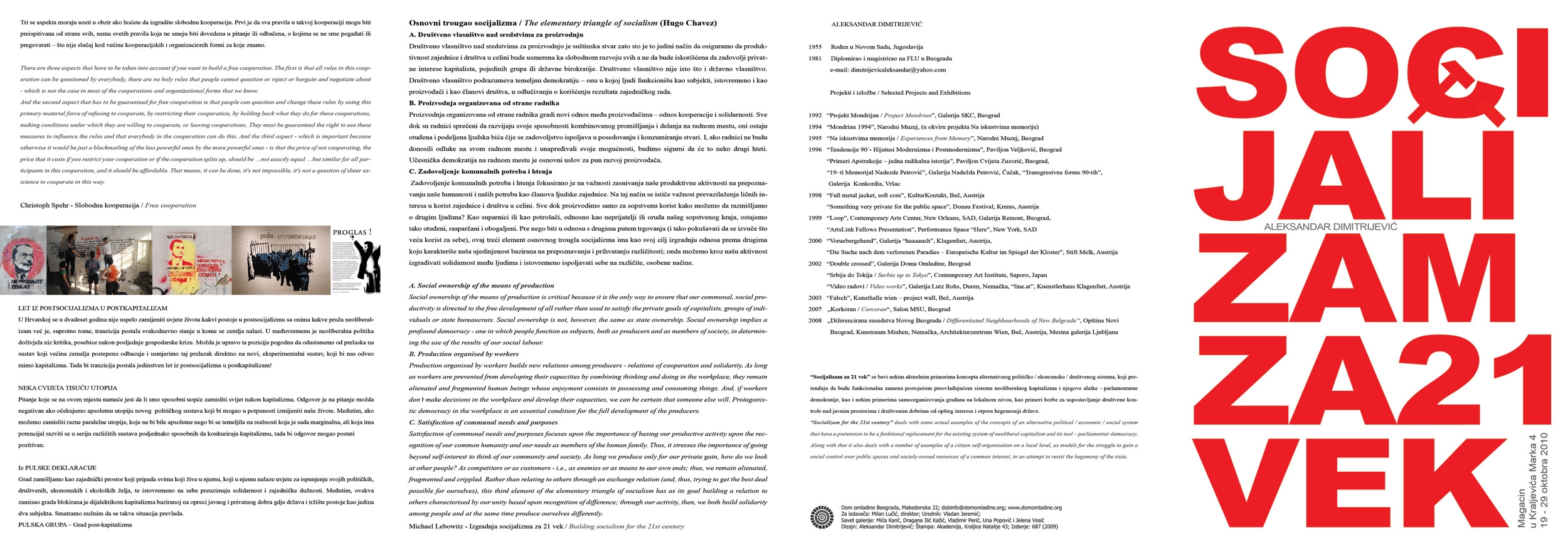
Postersa couple of posters based on selections from articles I have written that were exhibited by the Serbian artist Aleksandar Dimitrijevic at an exhibition in Belgrade 19th October 2010.Poster 1Poster 2 |
|
ELECTRONIC
PLEBISCITES Paper with Karen Renaud, We
suggest a technology and set of procedures by
which a major democratic de?cit of modern
society can be addressed. The mechanism, whilst
it makes limited use of cryptographic techniques
in the background, is based around objects and
procedures with which voters are currently
familiar. We believe that systems like this hold
considerable potential for the extension of
democratic participation and control.
Electronic and Athenian Democracy, paper given at the Workshop on e-Voting and e-Government in the UK, Feb 2006.
Videos
Talk on Towards
A New Socialism
Talk on Towards
and
Equivalence Economy
Audio
Talk on democracy given in Sweden in Nov 2010, this zip archive includes the audio as an mp3 plus the transcript of the audio as a pdf.Debate with Francis Spufford this is a recording of a discussion with Professor Francis Spufford at the Edinburgh Book Festival in 2010 associated with the launch of his book Red Plenty about Soviet Cybernetics. The podcast starts with an introduction by the science fiction author Ken Macleod, and then Francis speaks and then me ( for those who do not recognise our voices).
My review of his book is here.
My theoretical discussion of Kantorovich and Soviet cybernetics is in Mises, Kantorovich and Economic Computation .
Childrens Stories as they were actually told in Jan-Feb 2009 -- the Inspector McTaggart Series
Books
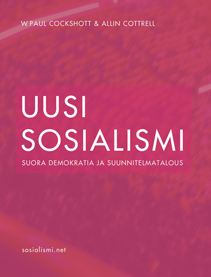 |
Uusi sosialismi |
Paul
Cockshott and Allin
Cottrell present a new
alternative to the capitalist market
economy. The book
explains how millions of different
products in the manufacturing of
society can be designed without having
to resort to capitalist markets and
bureaucratic arbitrariness. Direct
democratic planned economy, based on
their use of a working hours based
valuation system, super
computers and networks.
Originally published in English in 1993, the book has since been translated into Swedish (2002), Czech (2006) in German (2006), Spanish (2007) and Russian (2007). Sosialismi.netin now publish the Finnish-language edition which includes the original book in addition to an updated version of chapter 15, in 2008, written to the additional figures in the socialist calculation debate (Chapter 16), and socialism, the transition (Chapter 17), as well as a translation of the Czech language foreword. |
 |
Arguments
for
Socialism |
This
book is made up of a collection of
polemical articles written by us over
the period since the fall of ‘die Mauer’
and the crisis of the European socialist
movement brought on in its wake. They
record an attempt to argue through the
theoretical challenges that this period
has posed: * Why did both Leninist communism and Social Democracy come to crisis? * What were the economic weaknesses of both and what economic policy should a future socialist movement adopt to overcome these? Link to PDF version |
 |
EU
Am
Ende |
A
book on the Euro crisis in German of
which I am co author |
 |
Glasgow
Pascal
Compiler
with
Vector
Extensions |
This
book is a manual for the Glasgow Pascal
compiler, decribing both the standard
features of Pascal and the Vector
Extensions that allow efficient parallel
processing on modern multi-core chips. |
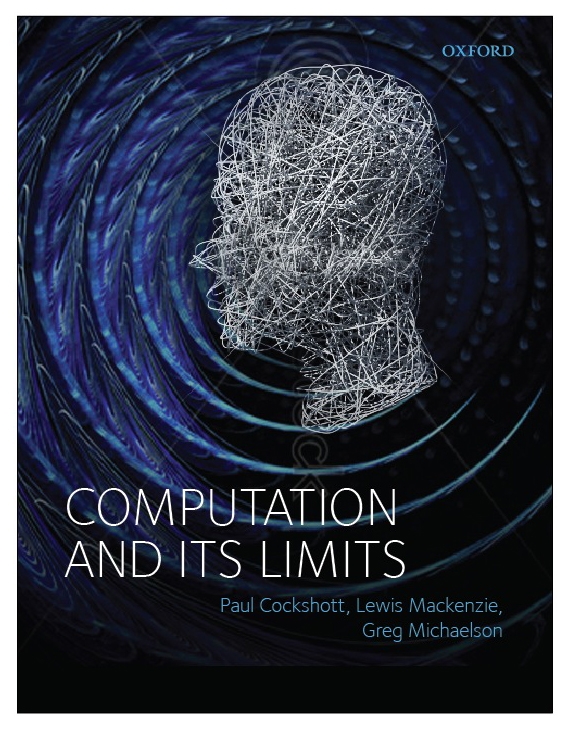 |
Computation
and
its Limits |
The
book
is an innovative cross-disciplinary
investigation of the relationship
between computing and physical
reality. It starts off investigating
the mystery of why mathematics is so
effective in science and seeks to
explain this in terms of the
modelling of one part of physical
reality by another. Going from the
origins of counting to the most
blue-skies proposals for novel
methods of computation the authors
investigate the extent to which the
laws of nature and of logic
constrain what we can compute. In
the process they examine formal
computability, the thermodynamics of
computation and the promise of
quantum computing. ( in press with
OUP) |
 |
Classical
Econophysics:
essays in thermodynamics,
information theory and political
economy |
A
book which examines the domain of
classical political economy using the
methodologies developed in recent years
both by the new discipline of
econo-physics and by computing science.
The book begins by examining the most
basic feature of economic life production
and asks what it is about
physical laws that allows production to
take place. How is it that human labour
is able to modify the world? It looks at
the role that information has played in
the process of mass production and the
extent to which human labour still
remains a key resource. The Ricardian
labour theory of value is re-examined in
the light of econophysics, presenting
agent based models in which the
Ricardian theory of value appears as an
emergent property. The authors present
models giving rise to the class
distribution of income, and the long
term evolution of profit rates in market
economies. |
 |
Simd
Programming
Manual for Linux and Windows |
A
book on programming for the SIMD
instructionsets of modern processors. It
looks at theese architectures and gives
examples in Vector Pascal, a language
that I developed for high performance
image processing. |
 |
Transition
to
21st century socialism in the European
Union |
A
book based on a socialist ecconomic
response to the credit crisis that was
put forward at a conference in Berlin in
Feb 2010 |
 |
Towards a New Socialism EPUB format |
English Edition of a book that has subsequently appeared in several languages (below). It examines the extent to which modern super computer technology allows both an efficient system of planned economy and enhanced democratic control of society using electronic voting. Note that the EPUB format is a relatively innacurate conversion from the original latex |
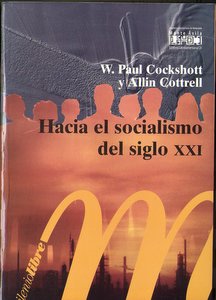 |
Hacia un NUEVO SOCIALISMO |
Spanish translation published in Venezuela. |
| К новому социализму | Russian translation, currently on the web, probably due for publication. | |
 |
Kybersocialismus |
The full text of the Czech edition of our book with the long extended introduction we wrote for this edition. |
 |
Sozialismus ist machbar | Extended German translation of Towards a New Socialism, containing the Czech introduction. This includes certain chapters elided from the German edition published by Papyrossa ( shown in picture). |
 |
Planhushållning
och
direktdemokrati |
Denna
bok,
skriven av en nationalekonom och en
datorforskare, visar inte bara att ett
annat sätt är möjligt - den visar också
hur det rent konkret kan förverkligas
med hjälp av modern datakraft och det
nätverksbyggande som brutit igenom i vår
tid. |
 |
PS-Algol
Implementations |
Describes
implementation
techniques for the persistent
programming language PS-algol. |
 |
A
Compiler Writer's Toolbox Interactive
Compilers for PCs With Turbo Pascal |
A
textbook on compiler construction
showing how to build high speed
interactive compilers after the idiom of
the Borland compilers. The example
compiler is an implementation of
PS-algol. The web link is to a version
of the book used as teaching notes here. |
Online Economics Papers
Laws of motion of Capitalism - this is a presentation developed by Dave Zachariah out of material that the two of us have discussed. It is in many ways a presentation of the key ideas of our Conservation Laws paper which is next in the list.
Conservation
laws, financial entropy and the Eurozone
crisis, with Dave Zachariah,
The report attempts of apply econophysics
concepts to the Eurozone crisis. It starts by
examining the idea of conservation laws as
applied to market economies. It formulates a
measure of financial entropy and gives numerical
simulations indicating that this tends to rise.
We discuss an analogue for free energy released
during this process. The concepts of real and
symbolic appropriation are introduced as a means
to analyse debt and taxation. We then examine
the conflict between the conservation laws that
apply to commodity exchange with the exponential
growth implied by capital accumulation and how
these have necessitated a sequence of
evolutionary forms for money, and go on to
present a simple stochastic model for the
formation of rates of interest and a model for
the time evolution of the rate of profit.
Finally we apply the conservation law model to examining the Euro Crisis and the European Stability pact, arguing that if the laws we hypothesise actually hold, then the goals of the stability pact are unobtainable.
Testing the labour theory of value : an exchange
An exchange with Shimshon Bichler and Jonathan Nitzan stemming from an open letter originally posted by Stefanos Kourkoulakos regarding the conference Crisis of Capital, Crisis of Theory held at York University Canada.
Methods of modelling in the light of information theory and entropy, a paper prepared for the conference Nuevos paradigmas en la economía y ciencias sociales del Siglo XXI , to be held in Mexico City, October 2010 ( link disabled whilst paper is reviewed). Power point presentation slides here.
CREDIT CRUNCH: ORIGINS AND ORIENTATION PAUL COCKSHOTT AND DAVE ZACHARIAH , an article which looks at the causes of the credit crisis and how economic policy should respond to it.
Supplementary chapters for the draft French edition of Towards a New Socialism. These chapters were written in 2008 for a proposed French edition, but the French publisher withdrew after we had written the chapters. Since the chapters relate to general updateing of the work, and as such may be of interest to English language readers, I have made them available here.
Hilbert Space Models Commodity Exchanges Abstract. It is argued that the vector space measures used to mea- sure closeness of market prices to predictors for market prices are invalid because of the observed metric of commodity space. An alternative representation in Hilbert space within which such measures do apply is proposed. It is shown that commodity exchanges can be modeled by the application of unitary operators to this space.
Information and mass
production
Babbage to Boltzman
Information theory whilst it grew out of the
needs of the telecoms industry, was built on
foundations provided by 19th century
thermodynamics. Its domain of application has
over the years been seen to widen. This talk
shows how information theory helps us understand
the key processes that made the industrial
revolution possible, by examining the close
connection between entropy, information
and the technologies of mass production.
Ambedcar,
Baudrillard,
Buddhism and Socialism An extended
introduction to a proposed Indian edition of
Towards a New Socialism that attempts to situate
our work with respect to the Buddhist Socialism
of the famous Dalit leader and intellectual
Ambedcar.
Mises,
Kantorovich and Economic Computation An
article that reviews the work of Kantorovich in
the light of von Mises claim that rational
calculations were impossible without markets. It
gives a tutorial introduction to the use of
Kantorovich's methods, compares his approach to
that of Dantzig. An assesment is given of the
extent to which new interior point methods of
linear programming strengthen or weaken
Kantorovich's claims.Russian edition available
as In
Natura
Calculation
from Neurath to Kantorovich (
Расчёт в натуральной форме, от Нейрата до
Канторовича ).
21st Century Marxism it was written for Junge Welt, a German left daily, in advance of a Berlin conference on Marxism for the 21st Century
Cantor Diagonalisation and Planning,Murphy (2006) recently argued that one could use the diagonal argument of the number theorist Cantor to elucidate issues that arose in the socialist calculation debate of the 1930s. We will here argue that Murphy's argument has certain problems, both at the number theoretic level and from the standpoint of economic realism.
Boettke Syntax and the Turing Test, a reply by Greg Michaelson, Allin Cottrell and I to a paper on Methodology by Boettke which he published in Cahiers D’Epistemolgie. Boettke is a prominent economist of the Austrian school.
Computers and the Economic Calculation Debate, talk given in Jan 2006 in Berlin.
Application of Artificial Intelligence Techniques to Economic Planning (pdf), HTML version, Paper dates from the early 1990s but was recently OCRed by Helmut Dunkhase to make it accessible over the web.
Information, Work, and Meaning an introduction to information theory by me and Greg Michaelson, it relationship to thermodynamics and to classical political economy with particular emphasis on how it applies to industrial mass production.
What is at stake in the debate on value ( pdf version ). '> html version. Paper outlines the empirical data on correlations between labour values and prices and discusses various objections that have been raised in the literature to these.
Demography and long term profit rates We discuss the original formulation of the theory of the falling rate of profit by Marx and the criticisms of the theory’s micro-foundations by Roemer. We then counterpose to this an alternative macroeconomic interpretation in which the falling rate of profit is driven by demographic factors. We follow this up with an examination of why the assumptions made in Roemer’s analysis are empirically unjustified. In particular we criticize his use of the average rate of profit rather than the monetary interest rate as the regulator of investment decisions. We conclude with an examination of the social implications of a declining rate of profit.
Reflections on economic democracy, paper that is appearing in Research in Political Economy
A Note on the Significance of the Standard Commodity in Sraffa's System, a joint paper with Ajit Sinha. The paper discusses the role of the Standard Commodity as a numeraire. We argue that the heart of Sraffa’s motivation for introducing the Standard Commodity was the dependence of relative prices on technical conditions in the basic sector. We show, by constructing a large class of worked examples that the direction of price movements under technical change will be dependent on the numeraire. If the choice of numeraire is arbitrary then so are the relative movement directions of prices under technical change. Joint.pdf, Pretty print output of a program to evaluate the hypothesis that the direction of movement of a commodities price under technical change can be dependent on the numeraire. This is the program used to evaluate the hypothesis discussed above. The Vector Pascal source of the program is available as Joint.pas
Symmetries and exchange relations, Exploration of how to use metric space theory to develop the chartalist theory of money.
Hunting productive work. The paper, jointly with Dave Zacharaih summarises the definitions of productive labour derived from Smith and Marx. It attempts to develop a more general definition deriving from Sraffa's standard commodity and the theory of relative surplus value. The implications of the new definition for the examination of highly socialised capitalist economies like Sweden are examined. .
Vector Space Metrics in Economics. Argues that capitalist economic activity can be modeled by rotation operators acting on a Hilbert space.
The organic composition of
capital and profit rates, Appeared 2003 in
Cambridge Journal of Economics. Shows that
industries with high organic composition have
low profit rates. The source data for this is
available to others as a spreadsheet
,that shows the rates of profit by industry for
the USA in 1987, against the organic composition
of capital for these industries. It shows, that
counter to expectation, industries with a high
organic composition of capital have a low rate
of profit and vice versa. The spreadsheet is an
excel one.
The
Scientific Status of the Labour Theory of
Value, a paper which uses Chaitin
Kolmogorov complexity theory to evaluate the
accuracy of the predictions of different
economic theories of valuee.
Value, markets and socialism Examines the very limited role for markets in a socialist economy and the different form of appearance that value ( abstract labour ) has in such an economy.
Value's Law Value's Metric: RR-94-168 An investigation into the metric space generated by commodity exchange. Provides empirical data comparing labour and electricity as the possible supports for this metric space.
Notes on Dynamic Value (pdf version) An attempt to come up with a simultaneist value theory that handles fixed capital and technical change.
The declining rate of profit and technical change an examination of the effect of moral depreciation on profit rates. An version in postscript is also available.
Testing Marx: Some new results from UK data This paper was published in the Spring 1995 edition of Capital and Class. It covers among other topics the degree to which industrial output prices in the UK correspond to those predicted by labour values. Corrections to the data originally published.
Value price transformation as a real process : rr-167-94 Published as "Does Marx Need to Transform?", by Allin Cottrell and Paul Cockshott for a conference on the centenary of the publication of Volume 3 of Marx's Capital, which took place in Bergamo in December 1994. The paper argues, on an empirical basis, that actual prices fall somewhere between the untransformed labor values of Capital, Volume 1, and the prices of production discussed by Marx in Volume 3.
Information and
economics A critique of Hayek : rr-166-94
Written jointly with Allin Cottrell, looks at
the concept of information as presented by Hayek
and compares it with that used in modern
information theory. It questions the extent to
which Hayeks economic conclusions are
sustainable on information theoretic grounds.
Russian edition
Information and economics, ( Информация и
экономика: критика Хайека)
An extended
and
updated version of this paper was
produced in 2007 that reinforced the
original conclusions with recent results in
economic computability theory.
"Calculation, Complexity and Planning: The Socialist Calculation Debate Once Again," by Allin Cottrell and Paul Cockshott, published in ROPE, summer 1993. We present a counter-argument against Mises' charge that rational economic calculation is impossible under socialism (a charge recently revived by Don Lavoie). The paper also considers other contributors to the Socialist Calculation Debate, such as Oskar Lange.
"Socialist Planning after the Collapse of the Soviet Union", by Allin Cottrell and Paul Cockshott, published in Revue Europeene des Sciences Sociales, 1993. We make the argument that what failed in the USSR was not socialist planning as such, but a particular and definitely flawed variant of same, and suggest the outlines of an alternative system of planning. The paper is complementary to our 1993 book, "Towards a New Socialism."
Realisation
Crises and the Polarisation of
Capital:cse-02-93 pdf version
Foreign Language Papers
Chinese
金
融危机的根源与对策 "The root causes of the
financial crisis and countermeasures", translation
of the paper 'Credit Crunch, origins and
orientations', listed above in the English
language sections. Chinese Abstract reads: 摘要:美
刊《科学与社会》2010年7月号刊登了保罗·考克夏特和戴夫·扎卡里亚题为
《信用恐慌:起源与对策》的文章。作者通过回顾 20世纪资本主义的演变史,认
为新自由主义向食利者利益的倾斜导致经济中非生产性部门和人员越来越膨胀是金融兴盛也是其危机的根源。而当
今金融系统发挥了封建社会封建贵族和神职人员的
作用,通过它社会的积蓄越来越多地分配给银行家、空军战机和士兵,而使社会贫困化。世界人口红利正在消失也
是资本主义这种靠利润驱动的生产方式难以继续维
系的重要原因。作者提出了废除不公正的债务、取消剥削和投资社会化等应对战略。文章内容如下。Finnish
Ajatuksia
johtajuudesta
ja
demokratiasta
Sosialismi.net julkaisee Paul
Cockshottin Tukholman Socialistiskt
Forumissa 27.11.2010 pitämän esitelmän, jonka
otsikkona oli Ideas of Leadership and
Democracy (Ajatuksia johtajuudesta ja
demokratiasta). Esitelmän alkuosa
käsittelee vasemmiston perinteisiä
demokratiakäsityksiä sekä tavoitteita
parlamentaarisesta tasavallasta ja
neuvostotasavallasta, ja hylkää molemmat suoran
demokratian hyväksi. Esitelmän jälkimmäinen osa
käsittelee konkreettisia esityksiä sosialismiin
siirtymisen ensimmäisistä askelista, ja
loppuosassa Cockshott vastailee yleisön
kysymyksiin
German
Die
Technik
des Sozialismus existiert Title given
by the editors of Junge Welt to the printed
edition a talk I gave in Berlin.Oberhand gewinnen Der Kapitalismus verfügt über theoretische Grundlagen, die ihn bis heute zusammenhalten. Die Arbeiterklasse kann daher nur revolutionär sein, wenn sie eine politische Ökonomie der zukünftigen Gesellschaft entwickelt
Unerwartete Quelle Die Physik bestätigt den Marxismus Short article describing how the Gibbs Boltzman distribution of money derives from work of Yakovenko, and how statistical mechanics approaches give the same general predictions as the Adam Smith/Karl Marx theory of price.
Steuern für den Sozialismus Article on tax policy in Venezuela. It focuses on the limits to funding internal expenditure from dollar revenues for oil sales without an adequate internal tax base. Particular focus is paid to the conflict between attempting to maintain exchange controls and attempting to control Bolivar inflation when running a current account surplus. The exchange controls are there to prevent expatriation of revenue by the rich. The article argues that it would be better to have an effective tax on property incomes.
Zeit statt Geld Article on the problem of inflation in Venezuela and review of proposals for monetary reform in that country.
Hungarian
Új szocializmus felé This is a Hungarian introduction to the book 'Towards a New Socialism'. As far as I know the introduction is the only part of the book translated into Hungarian. The translation appears to date from 2006.Macedonian
Електронска
и атинска демократија Electronic and Athenian DemocracyГовор на Пол Кокшот во Стокхолм за директната демократија и економија во социјализм Ideas of Democracy
Against Nationalism
Против национализмот Was also published in the newspaper Време - Дома
Venezuela
and
New
Socialism
Венецуела и Новиот социјализам (интегрална верзија)
Economic planning, computers and labor values (Part One)Економско планирање, компјутери и трудови вредности (прв дел)
ТРАНЗИЦИЈА КОН СОЦИЈАЛИЗАМ НА 21-от ВЕКВО ЕВРОПСКАТА УНИЈА� Transition to 21st century socialism in the EUCREDIT CRUNCH: ORIGINS AND ORIENTATION Кредитна криза: Потекла и ориентација- [ Translate this page ]
Демократија и парламентаризам Democracy and Parliamentarianism Published in the Newspaper Време - Дома
Persian
Gain Advantage ( Title translated from the Persian ) Persian translation of the German Paper which first appeared as Oberhand Gewinnen below.
Polish
Jak
wspóczesna zyka udowadnia marksistowsk teori
wartoci? Polish translation of the paper
that originally appeared in German as Unerwartete
Quelle
Die Physik bestätigt den Marxismus .
It covers the relationship between thermodynamics
and the theory of value.W kierunku Nowego Socjalizmu, chapter from the book edited by Ressler that is based on the transcript an interview that I gave with the editor.
Portuguese
Revisão: O desenvolvimento do pensamento económico socialista, this is a review I did of Maurice Dobbs book 'The Development of Socialist Economic Thought'.
Russian
These are articles
or papers of mine that have been reproduced and
translated on Russian language web sites. Thanks
to Yuriy
Zhilovets and Sergei Markoff among
others for being so kind as to translate these..
- Information and economics, ( Информация и экономика: критика Хайека)
- Scientific status of
the labour theory of value, (Научный
статус трудовой теории стоимости )
- Venezuela
and new socialism, (Венесуэла и
новый социализм)
- Towards a new socialism , ( К новому социализму)
- In
Natura
Calculation
from
Neurath
to
Kantorovich ( Расчёт в
натуральной форме, от Нейрата до
Канторовича )
- Cantor Diagonalisation and Planning (Канторовская диагонализация и планирование)(
Spanish
LAS
COMPUTADORAS Y LA DEMOCRACIA ECONOMICA,
paper given at conference in Quito 2003,
subsequently extended for publication in Revista
de Economia Institutional in 2008 also in English as Computers and
Economic Democracy.Los Plebiscitos electrónicos a talk based on work by Karen Renaud and I that was given at a seminar in Barquisimeto in Venezuala in 2007. English version
Las ideas importantes del socialismo de siglo xxi Presents the ideas of an economy of equivalence and participatory democracy with particular focus on Mexico using economic examples from that country.
Swedish
DE STORA SPRŎGEN
An article examing capital accumulation in Britain
since the late 19th century and the implications
this has for China. Published in the Swedish
journal Clarte An English language draft is
available here
and has now appeared in English in the Bulletin of
Political Economy.För ett genomskinligt produktionssätt - W Paul Cockshott & Allain Cottrell röda rummet 3-02 PDF version
Assorted other papers are available on the Reality web site.
Page Editor: Information
Officer
Last Update: 16 May, 2005